Sunday, August 10, 2025

Captain Francis Read: Patriot, Privateer’s Prize, and Messenger to Lafayette

Sultana a 60 ton schooner similar to Liberty
During the research into the Reade/Jackson connection, we were able to come across information about Francis Read (1756-1818).  A transcription of historical documents from 1777-1778 found in the Library of Virginia archives told the story of a ship called Liberty being taken by a privateer ship called Harlequin.

Francis Reade was the master (or captain) of Liberty.

If you can't have a pirate in the family, being captured by pirates is the next best thing.

According to the documents, the schooner Liberty was taken by Harlequin and her commander John Stout on November 1, 1778 off  Cape Henry.  Liberty was listed as "a vessel of some 60 tons" and the Schooner along with her cargo was taken to New York.

At the time, New York was loyalist controlled so most likely John Stout was a loyalist privateer.  There wasn't any information found about him in a search though it was explained that there was little printed information about Loyalist commanders and what was printed was often printed under assumed names.

The ship's papers mostly contained receipts for payment of wages to the crew from Captain Francis Reade, but there are some interesting nuggets of information.

Per a deposition of Francis Reade he was born in Virginia and a subject of the United States of America.  He was master of the Liberty at the time of her capture on November 1, 1778.

He was appointed to his command by Norton and Beale of Williamsburg.  They together with Nicholas B Seabrook were owners of the ship and cargo and all three were residents of Virginia.

The Liberty was of 6 tons and had a crew of 12, all shipped in Virginia.  Her last voyage began at South Quay, Virginia for Bordeaux, France with a cargo of tobacco.  She was captured on her return voyage.

Within the ship's papers were the following items:

  • Printed French passport issued in the name of Duc de Penthievre on September 16, 1778 at the Ile de Re` to Francis Read of the Liberty allowing him to proceed to Virginia.
  • Bills of lading for goods shipped aboard the Liberty at Bordeaux and St Martin on the 5th and 17th of September 1778 by Samuel and I.H. Delap and consigned to Norton and Beale Williamsburg
  • Receipt in French from Francis Read for 6 cases of wine received in the Liberty at Bordeaux for Virginia dated September 2, 1778
  • An invoice for salt received on board the Liberty for Williamsburg at St Martin Ile de Re' September 17, 1778
  • Register for the Liberty issued at South Quay on June 13, 1778 by Christopher Calvert N.O. with a declaration by John H. Norton that the Liberty was built at North Hampton in 1777 and that he, Samuel Beale and Nicholas Seabrook are the sole owners
  • Permit issued at Roanoke, North Carolina for the Liberty to proceed in ballast for South Quay May 8, 1778
  • Certificate issued at Yorktown on May 2, 1778 by Lawrence Smith DNO that the master of the Liberty has registered and has on board 84 hogsheads of tobacco and 600 staves.
  • Sailing order from Norton and Beale Williamsburg June 4, 1778 to Captain Read enclosing letters to Messers Delap, Bordeaux and giving Captain Read liberty to vary their instructions.  For the return journey they suggest he should make for the eastern shore of Virginia and find out which port would be the safest to make for.  They consider the sand shoal near Smith Island a good inlet also Matchipongo and Hog Island.  A list of their agents in Europe and the West Indies is appended

While all this is pretty interesting, the most notable and interesting thing is that there was a piece of paper on which was written "Inclosed [sic] is a letter for General de La Fayette.  It went on to say "Recommended by James Sauvage to Captain Read's particular care"

The letter itself was in French and was unsigned but had the heading "Bordeaux 5 Sept 1778 to Monsieur le marquis de La Fayette, General Major au service des estat unis de l'Ameique a` l'Armee"

The writer seemed to be, based on the context, Lafayette's wife, but the letter contained little of interest.  It merely had affectionate greetings and the statement that the writer was leaving Bordeaux the next day to return to their poor little Anastasie whom they hoped to find well. 

So Captain Francis Read was important enough to be trusted with a personal letter to General Lafayette. 

Which is pretty freaking awesome.

South Quay: A Forgotten Port of War

It's also important to note that South Quay, Virginia (pronounce South Key) was a rendezvous for militia as early as 1712.  It was a site where where Colonial leaders met to make plans for war against the Indians, and was an important port of entry for supplies during the Revolutionary War. Unlike the major ports of Wilmington and Norfolk, the inlets of the Outer Banks of North Carolina were not blockaded by the British Navy.  Because of this, ships were able to travel to and from South Quay through the Albermarle Sound, up the Chowan River to the Blackwater River where South Quay was located.

During Colonial times it had a customhouse, a shipyard, and warehouses for tobacco and other exports. Today, South Quay is an unidentifiable spot of land along state route 189. There is nothing left to indicate it was once a busy port except a lonely historical marker noting the site.

The historical marker inscription reads "Nearby along the eastern bank of the Blackwater River once existed the community of South Quay, also sometimes called South Key, Old Quay, or Old South Quay. Founded by 1657, South Quay by 1701 had become the site of a landing and trading post. A customs house for international trade had been built at South Quay by 1776. During the Revolutionary War, supplies from overseas arrived there for the colonial army and at least two ships were built there. South Quay was destroyed by fire by British troops on 16 July 1781. The port was rebuilt, but its prominence diminished by the end of the 18th century, and eventually the community disappeared."

Norton, Beale, and Patriot Smuggling

Another interesting fact is that the owners of the Liberty Norton and Beale were supplying the Virginia Committee of Safety with powder and arms, smuggling them on their ships, Their instructions to Captain Read that told him he could vary their instructions but "for the return journey they suggest he should make for the eastern shore of Virginia and find out which port would be the safest to make for.  They consider the sand shoal near Smith Island a good inlet also Matchipongo and Hog Island." were basically instructions on avoiding the British Navy blockades. 

Captain Read’s Service

Further information found also shared some details about his service during the Revolutionary War.  According to affidavits acquired for a petition for a land grant by descendants of Francis Reade, he served in the Revolutionary War as a Lieutenant in the Navy.  He was first aboard the galley Manly under Captain Edward Travis, then transferred to the galley Henry under Captain Robert Tompkins before finally serving on the galley Dragon.  He served for a total of three years. 

So not only was Captain Francis Read a skilled mariner, but he was also a trusted messenger to Lafayette, a blockade runner, and without a doubt—a Patriot.

Sunday, July 27, 2025

Cracking the Case: Solving the Jackson–Reade Genealogy Mystery

The oral tradition passed down through generations of Jackson descendants hinted at a prestigious connection—claims of descent from the Reade family, a line tied by blood to figures such as George Washington, Thomas Nelson, Meriwether Lewis, and other notable leaders from colonial Virginia.

But in genealogy, family lore is just the beginning. The real challenge? Finding the paper trail—the records, documents, and DNA—that prove the story. And that’s where this six-year mystery began.

A Whisper, a Lead, and a Cousin with a Clue

My cousin Kelly and I were both intrigued. We’d heard that the Jacksons might be connected to the Reades—one of those “if this is true, it changes everything” kind of family claims. We didn’t want to chase ghosts, but we couldn’t resist the lure of proving it true or false.

We were told that a distant cousin had found something that confirmed the link—something about the Eastern Shore. Unfortunately, when I reached out to her through her Ancestry.com page, I learned she had passed away just a couple of months earlier. I hadn’t wanted answers handed to me—I just wanted a nudge in the right direction. But that door had closed.

Still, we had a few solid leads to start with.

What We Did Know

We knew with confidence that James Jackson (1790–1836) had married Frances Reade (1790–1818), and that Frances was the daughter of a Francis Reade. Confused? Don’t worry—we were too.

For clarity: Francis with an “is” is typically male, and Frances with an “es” is female.

Family lore also said that this Francis Reade descended from Col. George Reade and his wife Elizabeth Martiau. If true, that would link our family directly to early colonial founders, French Huguenots, and even royalty. It was the kind of legacy that sounds too good to be true. So, we started digging.

The Chancery Records Breakthrough

Hours turned into months, and months into years. But we eventually found gold in the Virginia Chancery Court Records. These records are a genealogist’s secret weapon—full of disputes over wills, land, and property, often revealing intimate details of family relationships.

Turns out, the Jacksons liked to sue each other. A lot.

In one case, we uncovered that Francis Reade had two sisters, Dorothy and Nancy, and two brothers, Bailey and Robert. Even more revealing: Frances, Nancy, Dorothy, Bailey and their father Francis, had died around the same time. Those deaths created a ripple effect that showed up in the chancery records—and gave us the first real confirmation that we were on the right path.

And then... nothing.

We hit dead end after dead end. We were just about ready to shelve the project.

Six Years In: A Return to Virginia

Fast-forward to June and July 2025. We decided to make one last push and planned a trip to Virginia—a long weekend of research, determination, and a little hope.

We visited the Middlesex County Courthouse but didn't find anything we didn't already have.  We also visited Gloucester County Courthouse, only to learn that two courthouse fires had destroyed most records before 1862. Strike one.

Then we turned to the Mathews Library, which houses a genealogy department and has an on-site genealogist. That’s where things started to shift. We began finding pieces of the Reade puzzle—mentions in land deeds, church records, and community histories—but we still weren’t sure which Reade was our Reade.

Enter: Artificial Intelligence

By this point, we’d also started using AI tools, including ChatGPT, to help comb through documents faster than we ever could manually. While AI couldn’t give us direct answers, it was incredibly helpful in highlighting patterns, surfacing lesser-known resources, and (crucially) suggesting that we might be chasing the wrong Francis.

The AI pointed us instead toward Benjamin or John Reade, not a string of “Francis Reades” as we had originally believed. That small shift in perspective opened up a new direction.

The Bible, the Ship, and the Breakthrough

Read Bible Excerpt

While at the library, I came across a Reade family Bible. Inside was a listing for a Rev. Thomas Read, son of Gwyn and Dorothy Reade, along with his siblings—including a Francis Reade born at the right time to be our missing link. We filed it away as “interesting, but unconfirmed.”

Later that evening, back at the house, we revisited what we’d collected and dug deeper. Using a combination of online records and a ChatGPT-assisted search that led us to the Library of Virginia, we found documentation about Captain Francis Read, who had a ship captured by privateers. He, too, fit the timeframe and location of our Francis.

LoVA Francis Reade ship capture

We went to bed exhausted, our minds spinning.

At 7 a.m. the next morning, I opened my door to find my cousin waiting for me, wide-eyed.

“I’ve been up since 4 a.m. I figured it out.”

And she had.

The Lineage Revealed

Our Francis Reade (1756–1818)—father of Frances Reade, wife of James Jackson—was the son of Gwyn and Dorothy Reade.

  • Gwyn Reade was the son of Benjamin Reade and Mary Gwynn, of the Gwynn family who founded Gwynn’s Island in Mathews County.

  • Benjamin Reade was the son of Col. George Reade and Elizabeth Martiau, tying us directly to:

    • Nicholas Martiau, early Jamestown settler

    • The Plantagenet kings of England

    • And the Merovingian dynasty

Just like that, the brick wall came tumbling down.

What’s Next

That discovery has opened up whole new avenues of research. We’re now looking into the life of Captain Francis Read, his siblings, and extended Reade cousins. There’s more to uncover, and we plan to share updates as we go.

This journey took six years, hundreds of hours of research, and a lot of dead ends. But in the end, persistence (and a little help from technology) brought it home.

So to all you genealogy sleuths out there still chasing a mystery—don’t give up. Your breakthrough might be waiting in a chancery record, a family Bible, or even a line in an old AI search you overlooked the first time.

On to the next challenge!


Tuesday, December 22, 2020

Christmas Ghost Story

"A sad tale's best for winter. I have one of spirits and goblins." so said Shakespeare in his play The Winter's Tale written in 1611. And in the popular Christmas song "The Most Wonderful Time of the Year" they even say "there'll be scary ghost stories".   I imagine to most people, the idea of telling ghost stories during the joyous holiday season seems strange, but it's actually a tradition that predates Charles Dickens' A Christmas Carol and even Shakespeare himself.  

Long ago, before Christianity took hold, the people of the world celebrated Pagan holidays.  During the winter on the longest night of the year, December 21st, it was believed that the veil between worlds was thin.  It was a time that signified death and rebirth.  And when Christianity began spreading, it also began incorporating the Pagan traditions into the Christian holidays.  Of course, Charles Dickens really got things going with his tale of the Christmas Carol and the ghost of ole Jacob Marley and the ghosts of Christmas Past, Present and Future.  But even the movie "It's a Wonderful Life" has its own strange paranormal occurrences.

In my family, sharing ghost stories was something that happened at nearly every large gathering, and especially at Christmas when everyone near and far seemed to gather together to celebrate.  I remember spending time with my cousin enthralled  listening to the stories told by the adults.  Some were made up, but many included true life encounters of the paranormal.  I can point to this and say here is where my love of the paranormal and the love of family history (also part of the tales) began. 

So on this Christmas holiday, I want to share a true ghost story that involves my family.  Unlike most of the stories I have, this one is a little different.  It isn't about something that happened to someone.  Rather, it involves someone from my grandfather and great uncle's past who became a ghost. And a rather famous one at that.  

The video below is an episode of Haunted History that featured the Baltimore area.  The story I'm going to reference begins at 14:30 and discusses a well known bar called Club Charles.   

While watching this episode, my aunt happened to see the photo of a man named Edward Neyt (at the 16:30 mark) and exclaimed, "That's Frenchie!". And that's when pieces began to fall into place.

As I mentioned, I have always had a fascination with the paranormal.  I've also always loved the old family stories, and one time my grandmother Pauline Jackson mentioned something about a friend of my grandfather Albert Jackson being a ghost at a bar in Baltimore.  Honestly, at the time, I didn't really pay much attention to what she said.  I forgot about it.  Fast forward a couple of decades (give or take).  I found myself down in the city of Baltimore somewhere near the Zodiac bar.  Somewhere out of the deep dark recesses of my brain, I dredged out some vague memory of my grandmother talking about a ghost in a bar and thought the bar she mentioned was the Zodiac.  I mentioned it to my companions.  That was my part in piecing together this puzzle.  So maybe another decade passes and my cousin says to me, "Hey did you know Pop's friend Frenchie in that photo is the ghost featured on Haunted History?" 

Going through some old family photos, we came across a couple that featured a man in a suit with Albert S. Jackson, our grandfather, and Charles L. Jackson, our great-uncle.  When asked about who it was, my dad and aunt explained it was a friend of my grandfather and great uncle's named Frenchie.  In the photo here, Frenchie is the gentleman standing at the horse's head.  My great uncle Charles Jackson is seated on the horse with a child.  

Frenchie was born Edouard AndrĂ© Neyt in France in 1925.  One record has his date of birth listed as 10 October 1925.  He died 12 May 1980.  During WWII, Edouard Neyt is said to have acted as a double agent.  He spied on the Nazis and reported his information to the French Resistance.  During my research, I found a WWII registration card for Edouard Neyt for the District of Columbia (Washington, DC).  There is no address information listed as place of residence, though there is a hotel in France listed as his mailing address.  His sister, a Mrs. Grisot, is listed as the person who will always know his address, and there is no registrant signature on the card.  The lack of information seems odd, unless, of course, he was acting as a spy.  Later, in August of 1950, Edouard enlisted in the US Army and served in the Korean War.  He was released from the military in August of 1952, and I assume that's the time he began his work as a waiter.  His first job as a waiter was with Miller Brothers and eventually The Harvey House where he worked for 20 years before his death in 1980. 

Sometime after his service, Edouard, or Frenchie, began frequenting the bar that would become the Club Charles.  Originally the bar was called The Wigwam and advertised "Grub and Firewater".  Frenchie lived in the apartment upstairs. Eventually, the owner of the bar Esther Martin renamed it the Club Charles.  Frenchie was well known at the bar.  He was there often after work drinking at the bar wearing his waiter's uniform of black pants, white shirt, tie and vest (much like the photo).  He was known as a charmer with the ladies, and he was also a known prankster who enjoyed jovially messing with people.  During Frenchie's time, there was a group of policemen and cab drivers who would meet to play a game of poker at the bar.  When Frenchie would return from work, he had a habit of going over to the group and playfully tussling their hair and trying to sit in their laps.

Sadly, Frenchie passed away in 1980 in his apartment above the bar from acute alcoholism according to the stories.  In his obituary, it says he was a friend of Mrs. Esther Martin who was the owner of the bar.  No other family is mentioned. 

But the spirit of Frenchie lives on.

After his death, employees of the bar began seeing a man in a waiter's uniform that would suddenly disappear.  Others have witnessed glasses moving off the shelf and floating in mid air for a moment before landing on the floor unbroken and completely intact. Bottles move and sometimes Frenchie turns on the beer tap.  He also enjoys "calling" employees on a payphone that doesn't accept incoming calls.  The phone continuously rings even after it's answered.  There is also a story about how a group of people playing poker felt something pulling at their hair. One person got so frustrated they shot a bullet into the ceiling yelling "Damn it French leave us alone!"

There's no doubt that Frenchie hasn't left the Club Charles.  I'm hoping one day in the near future I can visit and perhaps have a drink with my grandfather and great-uncle's old friend. 

Frenchie on the horse my grandfather on the right
 
1970 Baltimore Evening Sun clipping


Tuesday, December 1, 2020

Where Have I Been


I haven't posted anything since about a month prior to the start of the pandemic (I know I'm stating the obvious here).  I had a lot of plans for the spring and summer to do a little traveling with my cousin.  We planned to do some in person research at various court houses in the hopes of solving one of our biggest family mysteries (our Reade family connection that makes us cousins of George Washington and a direct descendant of Nicholas Martiau of Jamestown). Obviously, that wasn't able to happen.  So I planned out "to do" projects for when I would be home and not working for two weeks during the shut down.  But after a couple of days, my employer was allowed to open, and I've been working the entire time.  I'm very thankful for the normalcy of my work weeks, but disappointed that I had little time for research and blogging. 

That's not to say I haven't done anything.  I have been in contact with some members of my mom's family which has offered me some valuable information and validation that I don't normally have.  My mom being the youngest doesn't have all the information needed to validate what I may come across in my research.  It's been great to connect with cousins from my mom's dad's side of the family and also her mom's side of the family.  And I've also gathered bits and pieces of information here and there about other branches of my tree.

Sadly, in the time that I've been away from blogging, I lost my aunt.  It's been nearly 6 months, but I'm not really at a point where I can even discuss it.  But it makes me want to stress to everyone not to wait to get those stories and to get those photos ID'd.  My cousin and I thought we had time.  We didn't.  And that's all I'm going to say about that right now.  Go get that info while you can.

And other than all that, I've been trying to document what's happening in my small part of the world during this hugely historic time.  I jot down things I want to be sure to journal about so that future generations know what the world was like during the Covid 19 Pandemic.  Mostly I'll probably say it sucked I'm trying to include as many details as possible on how life changed.  I'm hopeful it will be normal again soon.  I have court houses to visit.

With all that being said, it's time for a little self care and that includes carving out time for something that interests me, brings high satisfaction (when I discover accurate information previously unknown) and offers an escape from the frustration of the world right now.  So I'm picking one night out of the week to be my genealogy night that is dedicated to research and blogging (or maybe 2 nights, one for research one for blogging). There are so many stories out there to be uncovered and shared, and I want to make sure I discover them while I can.  So I've made a dedicated space in my 140 year old house (that's haunted) where I research sitting at a desk made by my uncle with the rocking chair owned by my great great grandmother Lida Crooks Taylor behind me (it's haunted too). And I'll share some of these interesting stories I've uncovered. 

Friday, February 14, 2020

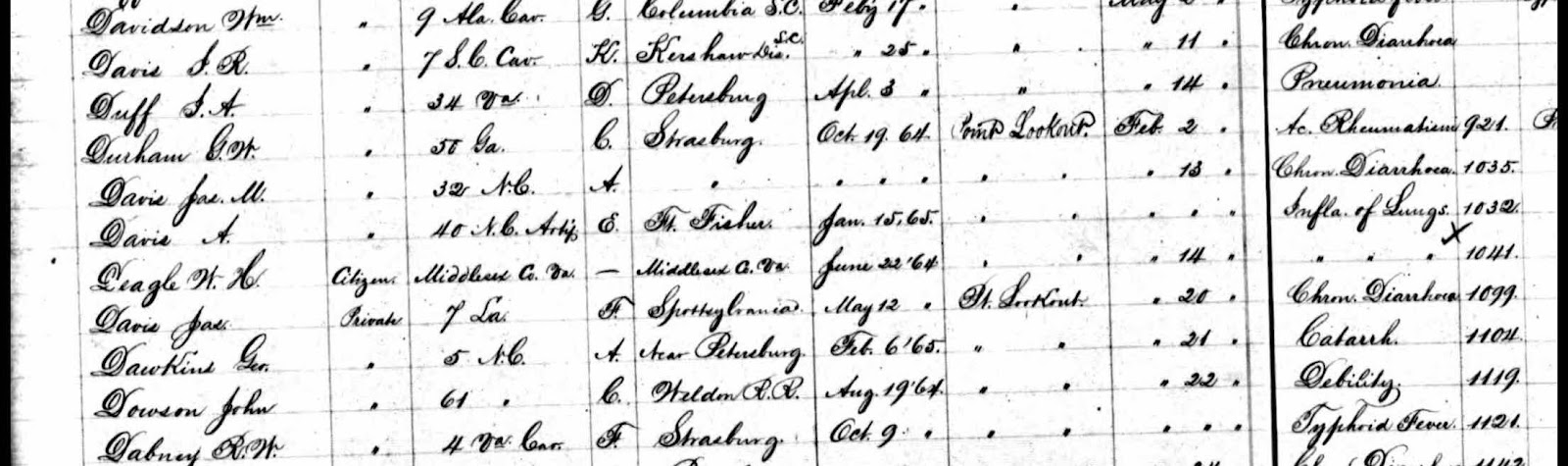
Valentine’s Anniversary: William Henry Deagle POW


William Henry Deagle, my 4th Great Uncle, was born about 1819 in Middlesex County, Virginia.  He was my great great grandmother LuElla Daniel Jackson's Uncle.  The 1860 census lists his occupation as "sailor", however, shortly after, he enlisted as a Private in the 109th Regiment of the Virginia Militia during the Civil War.  Not much is known about the 109th Regiment other than it was a Regiment out of Middlesex County Virginia.  In the book "Calendar of Virginia State Papers and Manuscripts" a one line description reads, "E.P. Jones to Governor- one company Calvary 55 men completely equipped 2 pair mules and a wagon for service of the state." Sometime before 1864, William Deagle was no longer in the 109th Regiment.
US Civil War POW Records 1861-64 National Archives
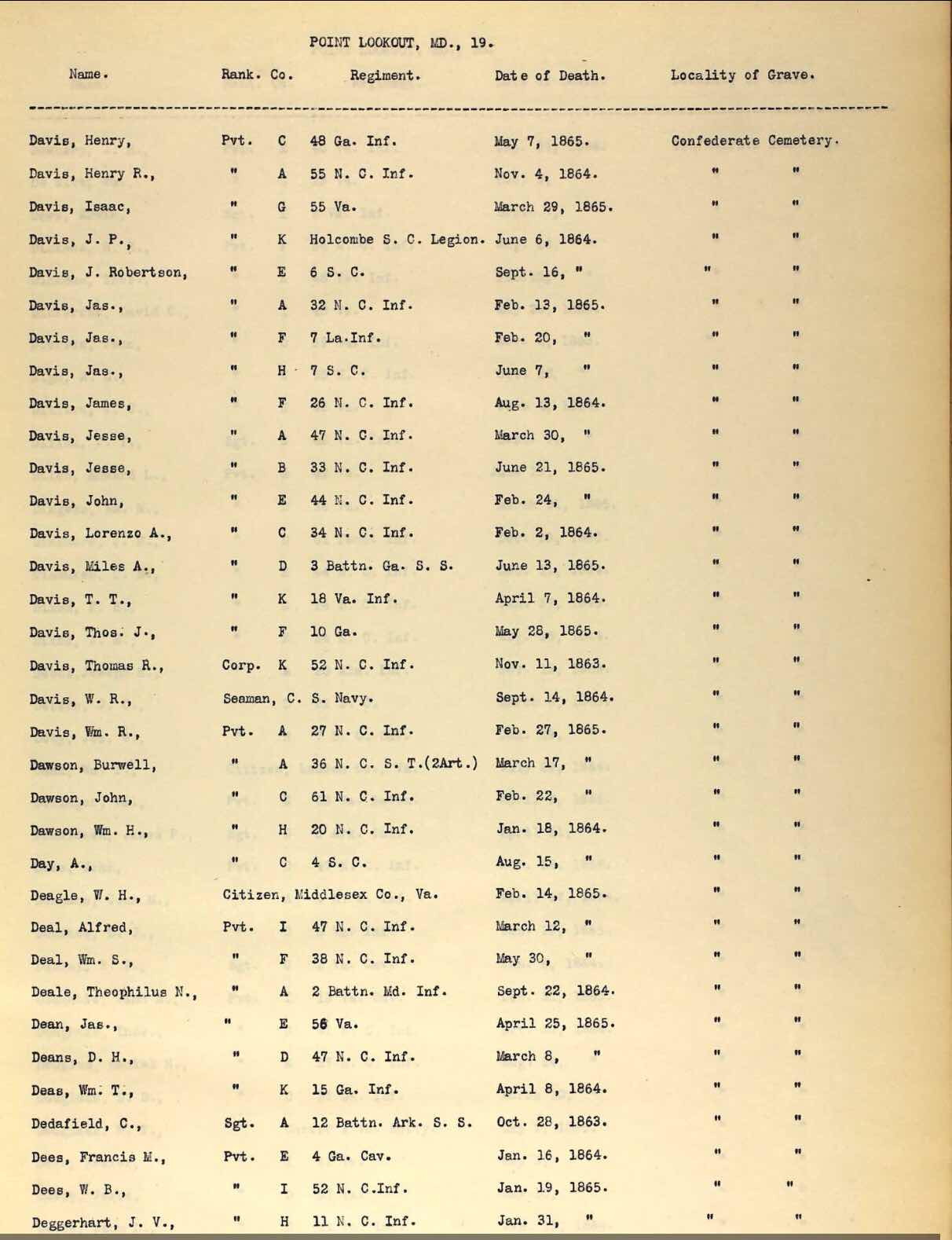
On June 22, 1864, William Henry Deagle was arrested by the Union in Middlesex County, VA and imprisoned at the Prisoner of War camp at Point Lookout in St. Mary's County, MD.  His "rank" is listed as Citizen.  During the Civil War, Lincoln's administration treated Southerners as people who willfully gave up their civil liberties due to secession.  Lincoln also suspended habeas corpus in areas of rebellion. (And before anyone gets bent out of shape, the Confederacy did the same and also declared martial law)  The Union arrested about 2,000 civilians in Maryland, Virginia and Washington, D.C. and called them political prisoners.  Political prisoner was a broad term because it included people accused of non political offenses.  Many of those arrested were accused or suspected of being spies, violators of military order or civilians suspected of disloyalty to the Union.
Upon his arrest, William Deagle was taken to Point Lookout to the Union run POW Camp located there.  At the time of his arrest, the prisoner exchange between the two armies was on hold which meant there were between 12,000-20,000 prisoners housed in a camp built to hold only 10,000 men.  The camp suffered extremely crowded conditions with 16 men to a tent.  The camp was known for its extremely poor sanitary conditions.  Point Lookout was the largest Union run POW camp, and it was the one with the worst reputation.

Sadly, William Deagle did not make it home after his arrest.  He died of inflammation of the lungs on Valentine's Day February 14, 1865 just 2 months before the end of the war.  Deagle was buried in the Prisoner's Grave Yard.  The cemetery was a mass grave that held the bodies of 3,384 Confederate POW's.  Some of those buried were claimed and relocated by their families, and the rest were interred in the Confederate Cemetery outside of Point Lookout State Park.


Monday, November 11, 2019

Blown to Atoms-USS Tulip Memorial


Today marks the 155th anniversary of the explosion of the USS Tulip.  Each year near the anniversary of the explosion and sinking of the Union gunboat the USS Tulip, Naval officers and men  from the nearby Patuxent Naval Air Station hold a memorial service for those who perished at the site of the USS Tulip Memorial and burial site along the St Mary's River in St. Inigoes, MD.


photo credit T. Jackson 
 The memorial service serves as a mini reunion of members of the Jackson family who are direct descendants of the pilot of the USS Tulip James R. Jackson (read about him here)

The following is the article that appeared in the Evening Star paper in Washington, DC 14 November 1864:
THE TERRIBLE CALAMITY ON THE LOWER POTOMAC

Blowing up of the Gunboat Tulip- Sixty Persons Killed Instantly- Capt. Smith and other Officers Blown to Atoms- Full Particulars of the Terrible Affair

     The Ella dispatch boat arrived at the Navy Yard this morning with dispatches from the flotilla and with Messrs. Wagstaff and Davis of the gunboat Tulip.
     We learn from this arrival the following particulars of the disastrous explosion on the Tulip, which took place Friday evening off Ragged Point, about 14 miles this side of St. Mary's River, in the Potomac, whereby over sixty lives were lost:
     The gunboat Tulip attached to the Potomac flotilla, left St. Mary's at 3p.m. on that day for the Navy Yard here for repairs, and when passing Ragged Point at 6 o'clock and 20 minutes, the boilers exploded with a terrific crash, rending the upper portion of the vessel to atoms, scalding the officers and crew and throwing them in all directions.  Seceral of those who escaped without serious injury ran immediately to lower the gig, but before they could get it down, the wreck of the Tulip sunk, carrying down with her most of those in board.
     Some of the officers and men seized what they could lay their hands on, and succeeded in keeping afloat for above an hour, until their condition was discovered by the tugboat Hudson, Capt. James Allen and Engineer R. Granger, which picked up ten, who are all that escaped from the ill-fated vessel.  The ten picked up were:- Ensign Wagstaff, executive officer, and Master's Mate Davis, (the only two who escaped injury;) Master's Mate Reynolds, with leg broken, and Engineer Teel, very badly wounded, with six men.
     The Hudson's officers searched diligently among the floating pieces of wreck, but succeeded in finding no others than those mentioned above and steamed on to St. Inigoes.
     Messrs. Wagstaff and Davis took the Ella for this city, and the others were sent to Point Lookout, where two of them died on Saturday.  The Hudson's officers and men, when the survivors were got on board, immediately prepared coffee and refreshments for them, and gave them the kindest attention.
     There were on board the Tulip at the time of the accident 69 officers and men, including the following: Acting Master W.H. Smith, who hails from Philadelphia; Ensign Wagstaff, Acting Master's Mates Davis, Reynolds, Roffenburg, Hammond and Simons, Engineers Parks, Gordon and Teel.  We understand that when she started there was steam on but one boiler, but before proceeding far, steam was raised on the other, and the boat was proceeding slowly up the river.  The first intimation of danger was a cry from Mr. Gordon, who was the engineer on watch, to run to the safety valve and he made his way to the engine room, but scarcely had he gone through the door when the explosion took place.  At this time Captain Smith, the pilot James Jackson, Master's Mate Hammond, and the quartermaster were on the bridge over the boilers, and must have been blown to atoms.  The only trace left of Capt. Smith was his hat.
     As but ten persons were picked up, 59 persons must have lost their lives instantly, and two of those saved, died before the Ella left St. Inigoes.  Two or three others of the ten saved are not expected to live, among them, we regret to learn, Ensign Teel.
     Capt. Smith has been attached to the flotilla for about two years past, and was a much esteemed young officer.  He hails from Philadelphia, and after receiving his orders on Friday before leaving, he telegraphed to his wife that he would meet her at the Depot this morning, but alas his expectations were vain!  Engineer G.F. Parks, who was in charge of the engines, and went down in the wreck, hails from Brooklyn, where he leaves a wife and three children, with an aged mother.  Engineer John Gordon, who was also also lost, hails from Philadelphia, where he leaves a family.
     The Tulip was one of the vessels built at New York, for Mandarin Ward, of China, and after his death, the Government, purchased the Tulip and the Fuschia, another of Ward's vessels.
     Both vessels were fitted up here for service in the flotilla, Acting Ensign Sluyter being the first commander of the Tulip.  Acting Ensign Shurlett succeeded Capt. Sluyter, but was afterwards transferred to the Commodore Read, on being relieved by Capt. Smith.  The Tulip was a fine staunch propeller (4th class) of 183 tons, carrying 5 guns, but at the same time of the explosion had not the full compliment of men.  It has been some months since she has had and overhauling and it is stated that some parties at least considered her boilers unsafe.  Four months ago two engineers who were attached to her- Jeremiah Riddle and John T. Buckley- reported her boilers unseaworthy and it is stated refused to run the boat and they were suspended for a time and assigned to subordinate positions.  Doubtless the Department will order and investigation into the circumstances of her loss.

The next day on 15 November 1864 the official findings were printed in the Evening Star.  There were 57 officers and men aboard the Tulip when she exploded.  Of those 57, 10 were saved, however, 2 of the 10 later died bringing the total dead to 49.  The Tulip was ordered to leave St. Inigoes and travel to the U.S. Naval Yard, Washington to undergo repairs to the starboard boiler that had been deemed unsafe.  The Captain was told under no circumstances was the starboard boiler to be used.  Unfortunately, that order wasn't followed, and the firing of the starboard boiler was the cause of the explosion.  Here is a letter from the U.S. steamer Juniper that was tasked with searching for remains printed in the Evening Star along with the official cause of the explosion:
U.S. STEAMER JUNIPER, Potomac Flotilla Nov 13-  F.A. Parker, Com'd'r Commanding Potomac Flotilla- Sir: In obedience to your orders of the 12th inst., I proceeded to Ragged Point in search of the bodies and remains of the U.S. steamer Tulip, which was blown up by steam on the eve of the 11th instant off that point.  I sent out two boats and landed on the beach, where I found large fragments of her remains.  I found a trunk belonging to Acting Master's Mate Reynolds, of that vessel, a valise belonging to the pilot, a coat, bag, ad several blue shirts and a number of officers' caps.  I also found two sponges, a lot of letters marked U.S. steamer Tulip, large portions of her deck, the top of her pilot house, and her first cutter lay on the beach, but up to the present time I have not been able to find any bodies.
                                    Very respectfully your ob't serv't
                                     Philip Sheriden
                                     Acting Ensign Commanding

Eventually bodies and body parts starting finding their way to shore.  Remains were buried at a farm on Ragged Point (referred to Stinking Point due to the smell of the decaying bodies) after the pigs started eating them. The farmer agreed to have his slaves bury them if he could take personal items off the bodies.  Eight bodies, or pieces of bodies were found along the St. Mary's river, and these were interred on the shore in St. Inigoes, now the site of the smallest Federal Cemetery in the United States. 

Photo credit T. Jackson
I love that this memorial continues to keep not only Civil War history alive, but also our family's history as well.  


Thursday, September 26, 2019

Don't Forget the Present

The newest branch of the family tree
Sometimes in our pursuit of our history, we often forget that we should be recording the present.  I was thinking about this while in the hospital awaiting the arrival of my newest grandchild.  I was sitting there on my iPad researching on Ancestry (finding great things by the way) and it occurred to me that I hadn't included important dates for my children or grandchildren.  I certainly have their birthdays recorded, but I hadn't included information like baptisms.

My main interest in genealogy is learning the history of who I came from.  The human interest stories and photos peak my interest more than anything. I forget that I have stories and photos of people who are actually alive and breathing.  I also forget that these are people I need to get information from to have for future generations.

So in your quest for your family history, make sure that you're preserving the information about current events in the lives of the living for the people who come after us.

Also... I promise that I have some interesting things to blog about once I have a chance to catch my breath!

Tuesday, September 17, 2019

It Really is a Small World

I was recently discussing some family members with my dad.  He was talking about members of the Neighoff side of my family tree which would be part of my paternal grandmother's family.  Our talk turned to Casper Yeager my 3rd great grandfather.  His daughter Katherine Yager married David Neighoff which is the line I'm descended from.  My dad mentioned one of Casper's other children Alena (or Lena) Yeager who married a George Bauerline and lived in Carroll County, Maryland (Carroll County is where my immediate family ended up residing).  Curious to see who I might be related to in the area, I followed that branch of the tree.  Turns out (in my "it-really-is-a-small-world-revelation" number 1) that George Bauerline and Alena Yeager had a son named Andrew S Bauerline 1897-1996.  This son lived in the town I currently call home called Littlestown (it really is a little town).  The house where Andrew S. lived is still standing and is just about a minute away from my house.  I was pretty amazed to find a relative that lived in the town I ended up moving to.  I can attest to the fact that Littlestown is not an up and coming booming metropolis, so finding an unknown relative lived here is pretty unexpected. 
Andrew J. Bauerline
Continuing on (I promise, this all gets more amazing), Andrew S. Bauerline and his wife Stella Bartholow Bauerline had 4 children: Andrew J., Vernon, Elizabeth and Norman.  I began looking into Andrew J. Bauerline (1920-2007).  I ended up reading his obituary on Newspapers.com and was shocked to read that he lived in another nearby small town (smaller than Littlestown).  What was shocking was that I too lived in that same town at one time.  I lived there the same time he lived there and drove past his home on many, many occasions.  But the shock factor doesn't end there.  He was also a member of the local Catholic Church in that town and was buried there.  It's also important to note that Andrew J. was a veteran.  That is important because every year right before Memorial Day, the local Cub Scout Pack goes to this cemetery to place flags on the veterans' graves.  So, you guessed it, for 8 years now, my son and I have placed flags on the grave of my second cousin 2x removed without realizing it.  And this year, my grandson started participating in the Pack and will be continuing the tradition, though now I know and will be certain to take some time at his grave. 

Vernon Bauerline
I also looked into Andrew J.'s brother Vernon E. Bauerline (1922-1945).  Vernon was also a veteran. He served in the U.S. Army Air Forces during WWII.   He was a sergeant and a top turret gunner on a B-17G #42-31634 part of the 324th Bomber Squadron in the 91st Bomber Group.  Sadly, Vernon never made it home.  On his 12th bombing run, his plane was shot down over Germany and he and crew were killed in action.  He was only 22 at the time of his death.  
Even though he died too young, Vernon still managed to link his short life with mine.  In town, we have a monument dedicated to WWI, WWII and Korean War veterans from Littlestown who lost their lives in battle.  Every Memorial Day, both the Cub Scout Pack and the Boy Scout Troops participate in a parade that marches to the monument, takes time to lay wreaths in memory for the fallen and then continues on to the local cemetery where a ceremony is held.  Vernon Bauerline's name is carved on that monument in town. So like his brother Andrew J., we have been honoring Vernon Bauerline's ultimate sacrifice for our country for 8 years and never realized he was a relative.  
In my newspaper search for more information on Vernon, I came across a couple of articles from when he was a kid growing up in Littlestown.  One article in particular from October 12, 1935 detailed the weekly scout meeting which included adding 3 new members to the Troop. One of those new members was 13 year old Vernon Bauerline.  The Troop was Troop 84- the very same Troop my son is a member of and the one where my husband and I serve as leaders.
Truly a small world. 

Friday, August 30, 2019

The Fairy Mermaid of the Plantagenets

Have you ever looked at the Starbucks logo and wondered where exactly the inspiration came from? Me either, but I always thought it was a rather interesting logo.  Turns out, the logo was inspired by Melusine who was a female water spirit known to frequent fresh water rivers or sacred springs.  She was described as being human on the top half of her body, but fish like or serpent like on the bottom half of her body.  Sometimes she was described as having twin tails (much like the Starbucks logo) and sometimes had wings.  She was often referred to as a "fairy mermaid", and I'm most likely related to her.


It doesn't get much cooler than that (actually it does, but I have to reveal the cool one blog post at a time).

Melusine or Melusina as she is sometimes called, was the daughter of Pressina, who was a full on water fairy, and a mortal man by the name of King Elinas of Alba (now called Scotland).  It's interesting to note that King Elinas' mother is listed as "The Dragon Queen" (seriously, who needs Game of Thrones, just go research history).  Pressina told her husband she would marry him under one condition- that he never look upon her during or immediately following childbirth.  Elinas agreed and the two married.  Soon after, Pressina became pregnant and gave birth to triplet girls named Melusine, Melior and Plantina.  King Elinas ended up breaking his promise and went in to see his wife and new daughters shortly after they were born.  Upset that her husband broke his promise to her, Pressina took the three children and fled to a hidden island.  When the girls became teens, the eldest Melusine, learned of her father's betrayal and decided to punish him by kidnapping him and hide him in a mountain.  She talked her sisters into helping her with her plan of revenge.  But Pressina learned of the plan and punished Melusine by cursing her to turn into a mermaid like creature every Saturday.

Melusine goes to live alone in a forest where she meets Raymond, Count of Anjou who was distressed after accidentally killing his uncle during a boar hunt.  Melusine promised to help Raymond attain wealth and power and offered advice on how to explain his uncle's death.  Raymond was so pleased, he asked Melusine to marry him.  She agreed but only if he agreed never to come to her private chamber on Saturdays.  He agreed and they were married at once.

Melusine did help the Count gain power to the kingdom and became the mother of the Lusignan line.  She and Raymond had 10 children, and each was born with some type of deformity.  Raymond was eventually pressured into learning of Melusine's Saturday activities.  He peaked through the keyhole and saw her fish like lower half.  Raymond didn't say anything about what he saw at first.  It wasn't until his son Geoffrey burned a church and killed  100 monks that Raymond, feeling Melusine's secret meant she was an agent of Satan and the reason for Geoffrey's attack, blurted out that she was a false serpent.  Distraught over husband's betrayal, Melusine leaped out of the window and sway away in the river. (You'll remember from the previous post that Geoffrey the Count of Anjou was the beginning of the Plantagenets).

Many royals all the way back to Charlemagne claim descent from the Melusine and the Plantagenet still claim the lineage.  In fact, Richard I the Lionheart said, "We come from the Devil, and to the Devil we shall go" it's said he was referring to the story of Melusine.  The Plantagenet line (Anjou, Vere and Angevin) all go back to her.

I may be one of a few who think being descended from a twin tailed fairy mermaid is super cool, but trust me when I tell you, this isn't even the coolest part of this lineage.  Wait until you hear about the Merovingians!

Thursday, August 29, 2019

The Plantagenet Connection

I mentioned a bit ago that my cousin and I were searching for a specific family connection that would link us with the Plantagenet Kings of Europe.  And I promised to talk more about that in a blog post.  This is such a blog post.

For starters, some might not know just who I'm talking about when I mention the Plantagenets.  The Plantagenets were kings that reigned from 1154-1485.  There were 14 kings in all and 6 belonged to the houses of York and Lancaster.  The Plantagenet Kings are descended from Count Geoffrey of Anjou and Empress Matilda who was the daughter of English King Henry I.  Remember Geoffrey, he'll be important in my next blog post. 

Henry II
The first group of rulers were the Angevins from 1154-1216 followed by the Plantagenets 1216-1399 and the Houses of York and Lancaster 1399-1485.  The Angevins included Henry II, King Richard I also known as Richard the Lionheart and King John I.  Henry II introduced the concept of trial by jury, set up civil courts and introduced "double jeopardy" or the concept of not being able to be prosecuted for the same crime more than once.  During his reign, the churches came under the rule of the civil courts.  Prior to that they literally got away with murder. 

King Richard I "The Lionheart" was named Lionheart for his bravery in
Richard I
battle.  He spend less than a year (only about 10 months) in England during his reign.  The state of his French territories and leading the third Crusade occupied his time.  Richard spoke very little English and he had no children.  Robin Hood lived in Sherwood Forest in Nottinghamshire during the reign of Richard.

John I
After Richard came his brother King John I.  John was the acting king during his brother's absence during the third Crusade.  He lost Normandy and almost all the other English possessions in France to Philip II of France.  He's responsible for the magna carta giving justice to all.  The magna carta set England on the path to become a democratic country.  He introduced lawyers and the concept of human rights. 

Then came the kings who used the Plantagenet name.  King Henry III was the first one in 1216.  He was crowned at the age of 9 but didn't take full control until he was 20.  He was captured during a civil war and forced to set up Parliament.  He started the House of Commons.  Oxford and Cambridge universities were also established.

King Edward I came next.  He was called "Longshanks" as he was over 6 feet tall.  He was also called the "Hammer of the Scots" because of the wars he fought against the Scots and Robert the Bruce.  He was also a noted castle builder.

King Edward II was next.  He was the first Prince of Wales having been born in Wales.  He was defeated in his invasion of Scotland.  Most notable is that he was reported to have been murdered by his wife Isabella and her lover Roger de Mortimer so they could rule.  Some claim that they didn't actually murder Edward II but kidnapped him and kept him hidden.  Either way, makes a nice soap opera.

King Edward III was too young to rule at first so his mother the evil Isabel and her lover Mortimer had control.  At the age of 17, he assumed his royal powers, arrests and executes Mortimer and places his mother under lifetime house arrest.  He fought many battles against the French and Scots and created the House of Lords to separate the elected members or commoners from the Lords and Bishops.

That brings us to the last of the Plantagenet name (though not the line) Richard II.  Richard took the throne at the age of 10 and his uncle John of Gaunt ruled until he became of age.  He was eventually murdered by his cousin (John of Gaunt's son) so that he could become king.  Richard II ruled during the time of the port Chaucer.

The House of Lancaster began with Henry IV who became king after murdering his cousin which started the dispute between the Houses of York and Lancaster.  He died of leprosy in 1413.  And this is where I'm bring today's history lesson to a close.

Nicholas Martiau
So what does any of this have to do with the genealogy of my family you want to know?  Well there was mention that the Jackson were married into the Reade family who were descended from a member of Jamestown named Nicholas Martiau who was the grandfather of George Washington and other notable persons of history (Thomas Nelson, Augustine Warner, Merriweather Lewis....).  In addition, the lineage of the Reade family is well documented, so once there is a proven connection, that particular line would be completed and authenticated with basically no work on our part.  And the Readed are direct descendants of the Plantagenet line.

This connection is what got my cousin and I the most interested in doing serious genealogy research.  And it hasn't been an easy connection to prove, but we're about 90% there.  Prior to our research trip earlier this month, I was able to come across someone who had people from my line listed in hers.  And it was someone I was stuck on.  I contacted her, and she was gracious enough to give me access to her tree.  I was thrilled to learn that she had information that answered some questions about links to family, and more importantly, she has it cited. 

We knew we had a 5th great grandfather named James Jackson who married a Frances Reade.  We were able to find chancery court records that provided authentication of that information.  This new tree I found further conformed that and also provided information showing that our 5th great grandmother Frances Reade's father was Francis Reade.  It was one more generation closer to linking us with the Reade family from Jamestown. 

Mathews Library research
So during our time spent researching at the Mathews Memorial Library (highly recommend using their genealogy room and resources for your eastern VA research needs- super helpful staff!), we came across a book that gave us the next generation.  We found that our 6th great grandfather Francis Reade's parents were Francis Read and Lucy.  Lucy is potentially a Hunley.  This confirmed link now connects generationally (just made up that word) to the Francis Read that is listed as the son of Robert Reade III and links back to Martiau and all the rest.  While we do not have concrete proof of the relationship between the two Francis Reades (son of Robert and husband of Lucy) this is where we thought the connection would be, and so far all the evidence we've collected has begun lining up as we thought and leading us in that direction. 

I'm fairly certain we will find the connection.  We had another cousin who did extensive research and traveled around to courthouse looking through information, and she is the one who found the connection.  Sadly, she passed away earlier this year before we had a chance to meet her, and her research is lost to us. 

So hopefully this fall, there will be another trip to a courthouse to try and dig up the proof we need.
And for those wondering, the "we" I mention is myself and my cousin Kelly who is my partner in crime on this genealogy adventure. 

Stay tuned for some interesting history on the origins of the Plantagenets.

Tuesday, August 27, 2019

Tombstone Tuesday

Today's tombstone belongs to my great great grandmother 
Luella "Ella" Daniel 1868-1906
She is buried in Clarksburg United Methodist Church graveyard
in Deltaville, Va
She was the first wife of John Aaron Jackson, Sr.
 Ella was a member of the Order of the Eastern Star
which is shown on her headstone.
The Order of the Eastern Star is appendant body of the Freemasons that was started in 1850
but wasn't an approved appendant body of the Freemasons until 1873.
The Order of the Eastern Star was open to both men and women.
Men had to be Master Masons to join,
 and women had to have a significant relationship
with a mason to join.  
Ella's headstone is a newer addition 
having been added long after she was buried.

Sunday, August 25, 2019

Noah Franklin and the 55th VA at Gettysburg

Noah Francis Jackson was my 4th great uncle.  He was brother to James Robert Jackson (Tulip James).  Both brothers fought in the Civil War; Noah for the Confederacy and James for the Union.  James was killed during the war when the ship he was piloting exploded in the Potomac River.  Noah who served in the 55th VA Infantry Regiment survived the war.  One battle the 55th VA was involved in was Gettysburg- a location near my home.  Here is a video explaining the involvement of the 55th VA during the Battle of Gettysburg.


Thursday, August 22, 2019

Racehorse Jack

My great great grandfather John Aaron Jackson, Sr had a horse named Jack.
This is Jack.
You'll notice on the ground in front of Jack is a beat up old hat (trust me, that's a hat).  In order for John Aaron's son Wallace to get Jack to settle down enough to get his photo taken, Wallace had to lay his hat down on the ground.  Another interesting thing about this photo is that it shows the area where our current house on the creek stands now.  It's hard to believe there was ever such a clear view to the water (you can see the water in the background).

One of John Aaron's other sons John Aaron Jr. had a sulky cart and for fun he would hitch up Jack and take him out to race.
Not a picture of Jack or John Aaron photo public domain
A sulky, for those not familiar, is a lightweight, 2 wheeled single seat cart.  It was commonly used as transportation in rural areas, and today is used in harness racing.  The term sulky came about because people said the rider must prefer to be by themselves "sulking".  Apparently, back in the day it was also used for racing.  Many of the men in the area would hitch up their horses and race.  There was an actual race track just outside of town at Stingray Point owned by another family member where people would go to race.

Tuesday, August 20, 2019

Tombstone Tuesday

This weeks featured tombstone comes from the backyard of a private residence in Middlesex County, Virginia. During our genealogy trip, my cousin and I were told the location of the graves for Noah Francis Jackson, Sr and his wife Annie Eliza Crittenden.  The graves were located behind a private residence.  I must say, there's something about going up to someone's front door, knocking and then saying. "This might seem weird but do you have graves in your back yard?"  Luckily, we had found the right house, and the owner was happy to let us go check out the headstones.  She told us that she knew there were the 2 headstones for Noah and Annie and that there were also 2 infants buried there with no markers based on what she was told.
The headstones have been incorporated into a gorgeous perennial garden, and the owner said she does her best to see that the stones are treated with respect- which was obvious.


Annie Jackson's grave lists her birth year as 1841.  In my online research, I have a birth year of 1843 based on information listed on her marriage certificate that she was 16 in 1860.  She died December 12, 1905. Annie was a member of the Crittenden family which is another prominent name in the area.


Noah Francis Jackson Sr was born November 23, 1839.  He died February 5, 1909 according to research.  The death date on the headstone is below the soil line.   Noah Sr. was the brother to James Robert Jackson who my cousin and I refer to as "Tulip James" to differentiate between the other James R Jacksons in the tree.  Tulip James died during the Civil War aboard the USS Tulip.  Noah Frank (as he was called) also fought in the Civil War, though he managed to survive well past the surrender at Appomattox. He served in the 55th Infantry Regiment of Virginia and was present at many battles including Antietam and Gettysburg.  Noah Frank is one of those ancestors I am drawn to, mostly because I live only minutes from the Gettysburg Battlefield and visit there often.  I've also spent some time at Antietam.  I'm planning on a trip to both battlefields to take photos of monuments and areas where his regiment fought.


So far, I have had good luck being able to access family cemeteries on private property.  Keep in mind that you do need to get permission to go on someone's property.  In Virginia, property owners with private cemeteries are not allowed to deny access to descendants wanting to do genealogy research or visit family graves, though they can decide on dates, times and duration of visits.  You can read about it here.

Monday, August 12, 2019

Monday Monsters...er...Munsters

I have returned from my genealogy trip to Middlesex County, Virginia, and I must say, it was a successful trip.  I will get into the details of all that was learned, but I wanted to share these two interesting photos.  While talking with my cousins and sharing photos, he shared this photo of John Aaron Jackson, Jr:
John Aaron Jackson Jr (1887-1956) is my 2nd great uncle.  My cousins showed me this photo and referred to it as "Eddie Munster".  For those not familiar with Eddie Munster, he was the son of Herman Munster on the 1960's television show The Munsters.  Eddie Munster is the boy in the following photo.  No doubt, there is a resemblance.  But that isn't really the funny/creepy point of this post.
Last summer, my husband, son and I participated in our town's annual cabaret production.  The production was a celebration of the town's pool turning 50 years old and featured people portraying 1960's era television programs.  I was (of course) Velma from Scooby Doo.  My husband portrayed Herman Munster and my son, you guessed it, was Eddie.
Seeing the photos side by side was a bit uncanny, but what a thrill to have both photos for future generations!