Friday, June 14, 2019

Legalities of Graveyards


With the new discovery of potential family graveyards and the possibility that headstones were removed long ago, I was curious what all the rules were regarding having an old small cemetery on your property. 

In general, a property owner has two choices in regards to an old family cemetery on their property: allow it to stay or obtain a court order to relocate the graves.  In most areas, the property owner has no obligation to maintain an old cemetery other than any duty a local zoning ordinance might impose. Because the cemeteries I'll be traveling to are in Virginia, I looked into the Virginia laws pertaining to old family graveyards.

According to the Virginia Department of Historic Resources, Virginia property owners who have an old family cemetery on their property can choose to have it relocated if the cemetery is abandoned and is not historically significant.  Relocation of an old graveyard has several steps:

Reservation of Rights- a Reservation of Rights in regards to an old family cemetery is basically an easement that allows family or beneficiaries to make burials or visit and maintain a cemetery.  A title examination needs to happen to make sure there is no Reservation of Rights for the cemetery in question.

Is It Abandoned- It needs to be determined that the cemetery is in fact abandoned.  According to Virginia code an abandoned cemetery is one where no human remains have been buried there in 25 years or more, the cemetery is in a state of disrepair and/or it has not been maintained in any way for a substantial period of time

Historical Significance- An historically significant cemetery can not be relocated.  A cemetery is not deemed historically significant unless there is a historically significant person buried there, it has a unique architectural aspect or its connect to a historically significant place or event.

Archaeologist- While not required, it is advisable to hire an archaeologist to perform a cemetery mapping to confirm boundaries of the cemetery and the location of marked and unmarked graves.

Genealogist- Also advisable to have a genealogist locate descendants of those known to be buried in the cemetery and any beneficiaries of Reservations of Rights.  At a minimum, the homeowner needs to publish notices in local newspapers and alert local genealogy and historical societies in an attempt to local descendants.  Virginia requires a reasonable and good faith effort be made to notify the family or any descendants.

The property owner can then petition the local circuit court for an order of relocation to establish the cemetery where the graves would receive proper maintenance and care.  The property owner is responsible for all relocation costs.  It's best to contact the descendants to explain the relocation process and to establish goodwill.  The property owner could ask for permission to relocate the bodies at no expense to the descendants.  

The petition must name all parties in interest so it's best to include parties unknown.  The unknown parties must be served through local newspapers, and a guardian ad litem will be appointed for this unknown parties.  It is at the discretion of the circuit court whether the relocation is appropriate.  Sometimes relocation is ordered despite the objections of descendants.  There is a 30 day appeal period after the ruling after which time a licensed funeral home would handle the relocation process.

Before a petition is filed, the property owner should be aware of the expense in relocating graves.  In most cases, it is not economically feasible to relocate an old cemetery.  The relocation can involve numerous parties and high costs.

For those who are the descendants of people buried in an old family cemetery on another person's property, here are some highlights for you:

Access- Virginia law requires landowners to allow access to cemeteries on private property for visitation and genealogical research.  Descendants must give reasonable notice and abide by any landowner restrictions regarding frequency, hours and duration of access.

Property Owner Obligations- Per Virginia law, property owners are under no obligation to maintain a cemetery on their property.  However, Virginia law also protects all cemeteries from willful and malicious  damage, so don't destroy or remove headstones or otherwise desecrate graves. 

Maintenance- If a cemetery containing your family lies adjacent to your property and you feel it has fallen into disrepair, you can petition the city or county circuit court for relief including permission to access the property and maintain the cemetery.  You can also see if there is a reservation of rights associated with the cemetery that allows family access to visit and maintain the cemetery.  Information regarding the reservation of rights can be found on property deed information.  Make sure you search as far back as possible as this information can sometimes be accidentally left out of subsequent deeds.  Beneficiaries can also waive the reservation of rights.  If you are concerned, you can also contact the circuit court to find out how to ensure that you are contacted in the event the property owner petitions for removal and relocation of the graves.  Similarly, the heirs/descendants can also file a relocation petition.

So far, it's been my experience that if you treat people with respect and kindness, they are happy to allow you access to your family's cemetery without any issue, and most people have no desire to do harm to headstones or graves.  But it's always good to be aware of what is allowable by law.


Thursday, June 13, 2019

Try Crowdsourcing for Information

With the start of social media on the internet came all kinds of new terminology and ideas.  One of those ideas is Crowdsourcing.  A few months ago, we learned from our VA cousins that there was a rumor that an old family cemetery was located on some nearby property in Virginia.  Last month I took some time to try and see where a cemetery might be, but I never saw anything in my drives that looked promising.  There was a possibility that the information was just a rumor without any merit.  Still, I couldn't get past the idea that the potential cemetery could hold some clues to current brick walls in my family tree.  That's when I turned to Facebook.

Facebook groups can be an invaluable genealogy tool.  You can finds all kinds of groups pertaining to family history, and other groups, though not dedicated to genealogy, offer a place to answer questions about certain areas.  One of the groups I am a member of is a group dedicated to the Deltaville, VA area where much of the Jackson branch of the family settled.  Feeling as though I had nothing to lose, I posted a question about the possible location of the old family cemetery to the group.  And I hit pay dirt.
Area where one graveyard is possibly located.
I had someone who went out for a walk and found the location of one small graveyard, and then a huge influx of satellite photos with areas of potential interest outlined, suggestions of road locations where known small family cemeteries were and photos of a plat map with the graves marked with "X's".  I have about 7 locations to check on my upcoming vacation (my husband is thrilled). Sadly, there is a possibility that headstones are gone in some spots and in another area bodies were actually relocated to another larger cemetery in another town.  I am certain that there are at least 3 headstones still in place on one property.  The property owner was nice enough to send me a message with information and their phone number inviting me to come look at what they had. 

So if you're stuck on something and not sure where to go next, think outside the box a little and ask others who might have or be able to find the information to help.

I'm anxious now to get down south and search for graves!   


Tuesday, June 11, 2019

Tombstone Tuesday

Today's tombstone comes from my paternal grandmother's family.
Theodor Diedrich Heinrich Fangmann was my third great grandfather.
He was the father of Johanna Wilhelmina who I wrote about here.
He was born on December 20, 1827 in Oldenburg, Germany
 and died April 29, 1893 in Baltimore, MD.
His grave is at Holy Redeemer Cemetery in Baltimore, MD 

Monday, June 10, 2019

Tribute to Pauline

Where you used to be, there is a hole in the world, which I find myself constantly walking around in the daytime, and falling in at night. I miss you like hell. 
~Edna St Vincent Millay

My paternal grandmother was born Pauline Thelma Neighoff on
February 18, 1923.

Her parents were Thomas Jacob Neighoff and Emma Marie Scheufele.
She had 2 brothers Raymond and Vernon "Buck" Neighoff 
and a sister Evelyn Neighoff.
She married Albert S. Jackson and had 3 children:
Joyce, Patricia and Albert C. Jackson.
She passed away on June 10, 2010
after battling kidney disease and a host of other medical issues.

There are many things I remember about her:
  • She loved to garden and work outside.
  • She was extremely particular about how the grass was cut  and if you cut it, you better cut as close as possible to items in the yard
  • (like large cement planters)
  • Continuing on the grass cutting theme- she used to cut grass in bare feet even at our family vacation home in Virginia that barely had grass but did have a lot of pine cones, sticks and other bare foot hazards
  • She threatened bodily harm when my cousin and I were especially exasperating, but I can't remember a time when she actually went through with it (her catch phrase was "I'm going to crack you with this" and "this" was whatever she had in her hand at the time.)
  • She liked to read her "dirty books" the Enquirer and Star and most of us made fun of them, but secretly read them ourselves
  • She loved to read and she and I shared books even after I moved
  • When I was a kid she would read to me, though she didn't care for books about dinosaurs because she had trouble pronouncing their names
  • She hated her middle name and when I was being particularly bratty, I would call her Thelma sometimes in an exaggerated southern drawl
The one thing I remember the most about her was that no matter what, she had my back.  I could be dead wrong about something, she could know I was dead wrong, but it never mattered.  She would agree with me regardless.  And when I would eventually realize I was wrong, she would never say "I told you so" but make comments about how I should have been right.  It's something that I miss the most- having that person to be your champion even if you're being stupid and making a mistake.  That person who never judges you about any of it.

I miss her like hell.


Wednesday, June 5, 2019

Like Genealogy? Learn Cursive.

     This is a photo of a document in the Virginia Chancery court records.  It pertains to a lawsuit members of the Jackson family started regarding an inheritance from their mother's family.  I have found the Chancery court records to be helpful in coming up with names, guesstimates on death dates and things to use to further my search.  If you're in the process of looking for information on a        Virginia relative, I highly suggest taking the time to search the Virginia Chancery Court Records.  However, as you can clearly see, the records are handwritten- in cursive.  


          It's no secret that with the introduction of Common Core, cursive writing started going the way of the dinosaurs.  Currently, only 23 states out of 50 require teaching cursive writing to students.  I've always thought this was ridiculous.  More so when you realize there are some studies that show cursive writing helps improve brain development in areas like language, memory and thinking, helps improve focus and increased comprehension.  All these things are items I see as deficient in many students these days- including my own.  Generations are seriously losing the ability to read historic documents or even sign their name.  But with the discovery of these court records, it saddened me further to realize that generations will actually lose the ability to research and learn about their own personal history and families. 
     And the problem isn't just with the young generation who is still in school and was never taught cursive writing.  My generation is losing the ability to easily read cursive, and I speak from my own experience.  Most of my correspondence these days takes place on a computer screen or smartphone.  It's all typed.  So my ability to easily read through these court documents was hampered by my lack of practice.  With a little determination, I found it was like riding a bike and eventually was able to get through most of it. 
     I showed this document to my son, who is 13 and has no clue how to sign his name (he prints it, makes me think of the documents I've read with a large X for a signature) and finally this was the thing that motivated him to agree he needed to learn cursive writing.  He has an interest in genealogy and history and he realized it will be lost to him if he can't read it.
     So please, get your son or daughter or grandchild to learn how to write in cursive so family histories aren't lost!

Tuesday, June 4, 2019

Tombstone Tuesday

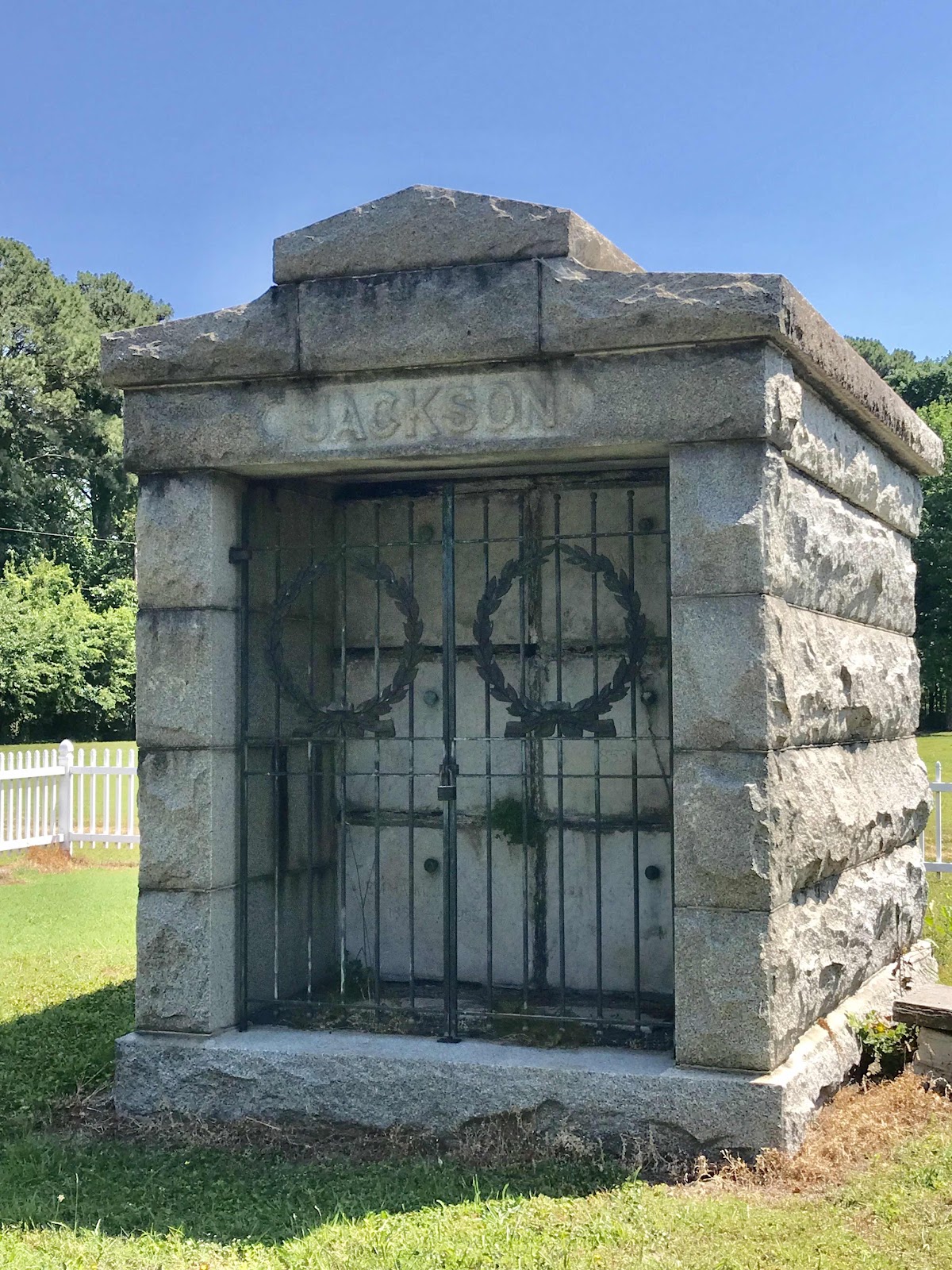
Today's Tuesday Tombstone is actually a mausoleum.
This is known as the Jackson Mausoleum
located on Jackson Creek.
I'm not sure that any of the Jacksons buried here are actually related to me,
though the odds are good there's a connection somewhere.
I traveled to this grave site to check on whether or not one of my relatives was buried there.
Find a Grave indicated he was.
I doubted it.
Turns out, I was right.
You need to be careful about some information out there.
Jacksons buried here are:
Nettie Alma Jackson Aug 3, 1857-Oct 16, 1858
Her parents were 
James Henry Jackson May 31, 1821- Oct 21, 1884
Annah Boss Jackson May 20, 1830- April 28, 1878?
Annah has shown up as possibly part of my direct line, but I don't think that's the case.
Others in the mausoleum are:
Moat Alexander Jackson January 22, 1855- May 10, 1927
Edith Jackson Selby 1853-1935
Emma M. Jackson 1856-1953
Rebecca Jackson Moses 1867-1947
William B. Jackson 1877-1944

I've seen some of these names floating around in ancestry trees
where they have been included in my family line
but not much matches up.

Any information anyone might have on the Jacksons listed above please contact me!


Monday, June 3, 2019

USS Jordan World War II

Albert S. Jackson
My grandfather Albert Stanley Jackson was born September 20, 1921 and died May 12, 1980.  He was a World War II Navy veteran who served as an electrician aboard the USS Jordan (DE-204) which was a Buckley Class destroyer escort.

The Jordan was manned by 15 officers and 198 enlisted men and was 306 feet long.  She was named for Julian Bethune Jordan, a 1925 Naval Academy graduate serving as assistant engineering officer.  During the attack on Pearl Harbor December 7, 1941, Julian B. Jordan perished on board the USS Oklahoma.

On June 5, 1943, the USS Jordan was laid down at the Charleston Navy Yard in Charleston, SC and launched on August 23, 1943.  The building of the USS Jordan broke the Charleston Navy Yard record for building a Destroyer Escort by a full 7 days taking only 52 days to complete.
USS Jordan (DE-204)
On December 17, 1943, the Jordan was commissioned and Lieutenant Commander F.C. Billing was in command.  After its shake down cruise, the USS Jordan arrived in New York in mid March 1944 for duty as an escort.  On April 17, 1944. the Jordan set sail for Gibraltar along with a convoy carrying vital cargo for Mediterranean operations  The Jordan along with the convoy arrived in the Mediterranean on May 1, 1944.  They returned to New York later that month and made one more trip to Europe in June before returning to be used as a training ship.  In July and August, the USS Jordan engaged in training exercises in Quonset Point, RI then arrived at Port Everglades, FL September 17th where she began conducting experimental exercises

In 1945, the USS Jordan spent a period of time at the Charleston Navy Yard before once again resuming radar and sound experiments.  May of 1945 found the Jordan making another trip to the Mediterranean as a convoy escort.  She returned June 20th and began engaging in submarine exercises in New London, CT and training exercises in Cuba.  Because of the experiments the USS Jordan was involved in conducting, new technological breakthroughs in anti-sub warfare were made which ultimately lead to a more powerful Navy and a shorter war.
On September 18, 1944 while on a training mission, the USS Jordan collided with a merchant vessel named the SS John Sherman and required immediate repairs.  She was sent back the the Charleston Navy Yard  and arrived October 4, 1944.  This is where the USS Jordan remained until she was decommissioned December 19, 1945.  Eventually the USS Jordan was sold for scrap July of 1947.
563 Destroyer Escorts protected convoys of men and materials from German U-Boats,  In the Pacific, they protected against Japanese Kamikaze attacks and Japanese submarines.  Today there is only 1 Destroyer Escort still afloat: the USS Slater.

Some say the "Battle of the Atlantic" was won because of the arrival of the Destroyer Escorts.  In the last two years of the war, threats from German U-Boats was nearly completely eliminated.

I'm lucky enough to have a few photos from my grandfather's time aboard the USS Jordan.
My grandmother Albert S Jackson on the far left
On board entertainment: Boxing
Boxing


Hijinx and shenanigans


If anyone knows who any of these other sailors are,
or if you know the areas being photographed
Please contact me!